
Are you planning on solo traveling or backpacking with your friends in Europe? Do you need help with where to even start? This blog is designed to help take some of your stress away on organizing a backpacking trip in Europe!
From my many solo backpacking trips while living in France to my 3 week trip after graduating college with my two best friends, I’ve become somewhat of a pro at low cost traveling with just a backpack. In this blog, I’m going to share my tips for how you can plan a 3 week backpacking trip to Europe on a budget.
Plus, I will even share what our budget was for our trip, since it might be hard to gage how much you need saved. I feel like no one talks about how much to prepare for, and this will help you decide your own budget going into your backpacking trip.
Planning a backpacking trip to Europe can be complicated if you’ve never been, but I will be breaking each step to take to make it as simple as possible!
At a glance:
- Deciding your budget
- Choosing your destinations + which cities I visited!
- Transportation
- Accommodations
- Itineraries
- Bon voyage!

1. Decide your budget
The most import part before you even begin your planning is to set your budget. Without a budget, it will be hard to determine which flights are best or what airbnb or hostel to stay in. Keep in mind, backpacking is SUPPOSED to be budget friendly. No one is going to backpack and spend $300 + a day on food, etc.
For this trip, we decided to make our budget a little bit more comfortable since we were celebrating graduating college. That being said, our budget ended up being $1,000 per person per week. This is what we set aside for each week for spending money, including accommodations, food, and experiences. We spent around $300 per person in accommodations each week, but this varied because some places were more pricey than others. Where we would save money from the less expensive places, we put that money towards the pricier cities.
After accommodations, this left about $700 per person per week (or $100 per day) for food and experiences, split equally at 50 each. For us, this was a very breathable budget. We felt that we could splurge on a nicer dinner or experience because some days we would only spend like $40-50 total since we didn’t pay for an experience that day.
Note: This was our budget comfortably eating out 2x per day. If you choose to cook a meal in or pack lunches when you go out, you’ll save more money!
Cooking in can save $100-200 per week depending on the type of meals you save on. I would recommend this for longer trips, and personally will probably do this as I travel more so I can stretch out my money!
You can also lower your budget for experiences in each city – we definitely didn’t use the whole budget each day. There were some cities where we’d spend more than others but that was because some tours or access to museums were pricier. You can definitely experience each city without really having to spend a dime on experiences! Be sure to check out free walking tours in each city too!
If you want to do an even more budget friendly style of backpacking Europe, check out this blog I found with great tips!
2. Choose Your Destinations
There are two ways you can go about choosing where you visit.
- Plan every city ahead of time
- Decide your destinations as you travel
For my friends and I, we planned everything ahead of time. In the long run, this will save you more money because flights, airbnbs, and hostels will get pricier the closer to when you need to book it. There is also the risk of them filling up.
The benefit of planning your trip as you go is that you can go to places you have never heard of before, based on recommendations from the people you meet! You will also have the chance to travel with your new friends.
If you’re traveling for a longer period of time (more than a month), I think it would be a lot easier to plan your trip as you go, with your first few places booked to start. This is because you will have so many opportunities pop up, plus there is less stress in making sure every detail is perfect before your start your journey.
For a month or less, I recommend planning your trip before hand!
My friends and I chose our destinations by making a presentation of the top 10 countries we wanted to visit, and why we wanted to go to the specific cities within those countries.
From there, we wrote down a list of our commonalities and narrowed them down to 7 countries and 11 cities.
To give you some inspo, here was our final itinerary:
1. 3 nights in Lisbon, Portugal
2. 2 nights in Madrid, Spain
3. 3 nights in Lyon, France
4. Day trip to Geneva, Switzerland
5. 3 nights in Paris, France
6. Day trip in Milan, Italy
7. 4 nights in Florence, Italy
8. Cinque Terre, Italy – last minute day trip, was supposed to be Venice!
9. 1 night in Rome, Italy
10. 3 nights on the island of Malta
11. 3 nights in Budapest, Hungary
For solo trip ideas, check out these blogs!
3. Transportation First
By Train
If you decide to plan everything ahead of time, I suggest you book your transportation before your accommodation because nothing would be worse than booking your hostel without any way to get there!
Once you decide on what countries you’re going to, draw lines on a map to look at them all at once. This will help you determine if they are close enough to take a train from place to place, or if you will need to fly.
If your destinations are 6 hours or under by train, I say take the train. The trains in Europe are very convenient and easy to figure out. They also have the Eurail pass so you can save money. They have passes for all types of travel for different durations! We initially wanted to take the Eurail, but our destinations were too far apart.
By Plane
Our main mode of transportation was by plane, except for some trains and Flix Buses here and there. If you go by plane, use Google Flights to help find the cheapest flight! You can use their “Explore” tab to find the cheapest destinations from your departure city.
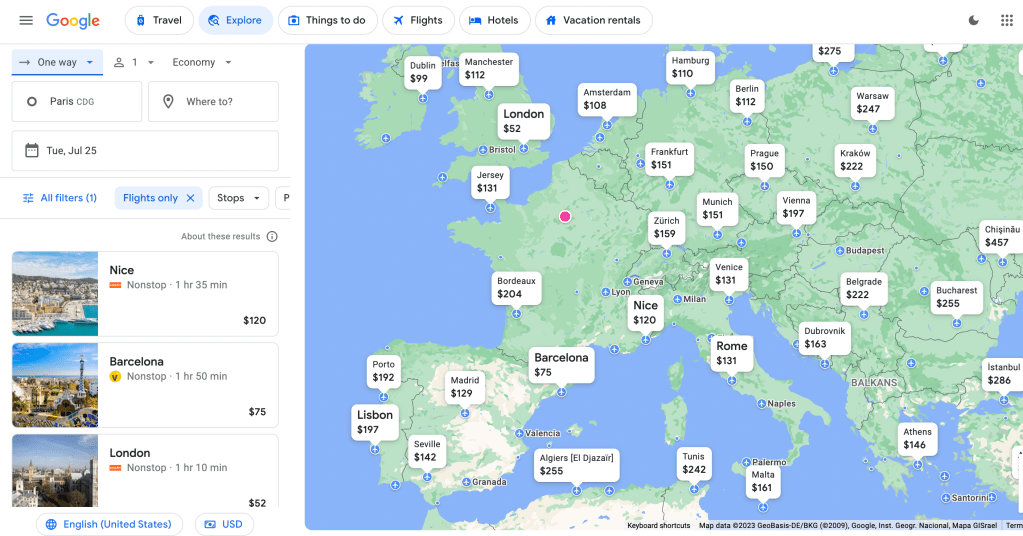
As you can see from this screen shot, I chose the departure city as Paris, and when looking at the one way flights, you can see which destinations are the cheapest.
We used this method for every flight we purchased. Also, we had originally wanted to go to Greece, but it was way to expensive for us to reach the islands, so we flew to Malta instead for $50!
We booked all of our flights over a 2-3 day period before we started looking at where we would stay in each city, to make sure we had a way of getting there.
4. Accommodations
As a budget traveler, hostels will be your best bet. If you are traveling with friends, then you’ll also be able to stay in Airbnbs for the same price as a hostel, if not cheaper.
We used HostelWorld.com to find our hostels. I love this website because it shows you how far each hostel is from the city center, the ratings, pictures, and other information! Also, if you download their app, you’ll be in a group chat with all of the other travelers to the city you’re staying in. This is perfect if you are looking to meet new people when traveling!
For us, we found it easier to stay in mostly AirBnbs. With 3 people, we were able to stay in a nicer place and have our own space for around the same cost of a hostel. In some cities like Paris and Florence, the AirBnbs were a lot pricier, but we saved a lot of money in cities like Budapest and Malta. So we moved the money we saved to the cities where we needed to spend more. It all worked out and our AirBnb’s were all really cute!
5. Itineraries
The final step before your trip is to prepare your itinerary for each city. Realistically, you only need to sketch out a few things you want to do each day so you have time to explore and do anything you come across.
For wine tours and boat excursions, we used Get Your Guide and AirBnb’s Experiences. Typically, we booked these experiences 1 day – 1 week in advance since we didn’t know exactly what we’d want to do yet. This worked perfectly for us!
6. Bon Voyage !
These were the major steps we took in preparing our backpacking trip to Europe on a budget. We started planning our trip maybe around 4 months in advance since we were full time students working part time jobs throughout the semester. It also took time to coordinate when we could all look at flights and hostels together since our schedules were crazy. We booked everything either in person together or on Facetime in order to be on the same page! You can definitely plan your trip a lot faster than we did if you don’t space it out!
I hope this guide to planning a backpacking trip to Europe on a budget helps! If you want more tips, message me on instagram @underthesun.blog!

 Under The Sun
Leave a reply to Fall Travel Deal : Save 10% on Transportation with Omio! – Under The Sun Cancel reply